Read further
By-law, PDF, 87 pages
Setback distances compared
What happened in Niagara-on-the-Lake
The science of pickleball noise, from the paddle face to the ear to the by-law
How to read this page
This page brings together what has been published about the sound of pickleball, drawn from peer-reviewed research, international acoustic standards, Health Canada and provincial guidance, and reports by acoustic consultants. Each statement is cited to its source so that readers can check it for themselves.
The sources are not equal, and the page says which is which. Some measurements come from consultants who work in pickleball sound mitigation, and some community surveys come from advocacy organizations. Measurements were taken with different instruments, at different distances and by different methods, so figures from one study cannot always be compared directly with another. Much of the health research concerns noise in general, most of it from road, rail and aircraft traffic, and is applied here with that limit stated.
This page is offered for public information. It is not engineering, medical or legal advice. A municipality relying on any figure here should confirm it with a qualified acoustic practitioner licensed in Ontario. Corrections are welcome and will be recorded on the Updates page.
Established Peer-reviewed research, international standards, government guidance.
Measured Consultant and field measurements, identified as such.
Reported Surveys, news accounts, commentary and conference summaries, used for context only.
Anyone who lives beside an outdoor pickleball court can describe the sound in a word. Pop. Crack. Clack. It is short, sharp and hollow, and it comes again and again, at no predictable interval, for as long as the courts are in use. What follows is an attempt to explain that sound properly: what it is, how the ear receives it, why the usual ways of measuring noise miss it, and why a noise by-law written for barking dogs and loud parties has so much trouble with it.
Human hearing is most sensitive to sounds between roughly 2,000 and 5,000 hertz, the range of a whistle or the consonants of speech [1]. Part of the reason is anatomy. The outer ear and ear canal act as a resonator that boosts sound pressure thirty to one hundred times at frequencies around 3,000 hertz [2]. The same resonance is why hearing damage tends to appear first in that range.
Because the ear favours some pitches over others, sound level meters are fitted with a filter, called A-weighting, that imitates it. The A-weighted decibel, written dBA, is the unit in almost every noise by-law. The filter was derived from a single loudness curve for pure tones, and research has shown that two sounds with the same dBA reading can be heard as quite different in loudness, depending on how their energy is spread across pitches [3]. The reference curves for how loud people hear different pitches are based on listeners aged 18 to 25 [4].
The brain treats an unexpected sound differently from a steady one. Laboratory studies of attention have recorded an involuntary shift of attention toward sounds that break an expected pattern, and have found that unpredictable sounds distract more than predictable ones [5]. Those studies used tones in a laboratory rather than recreational noise, so they explain a mechanism rather than measure pickleball, but the mechanism fits what neighbours describe: a sound that is hard to stop noticing.
The startle reflex, the full-body flinch, needs more than that. It is triggered by sounds above about 80 decibels with a very fast onset [6], and pickleball at a neighbouring home is usually well below that level. What neighbours describe is better explained by attention: each pop draws the ear back to it.
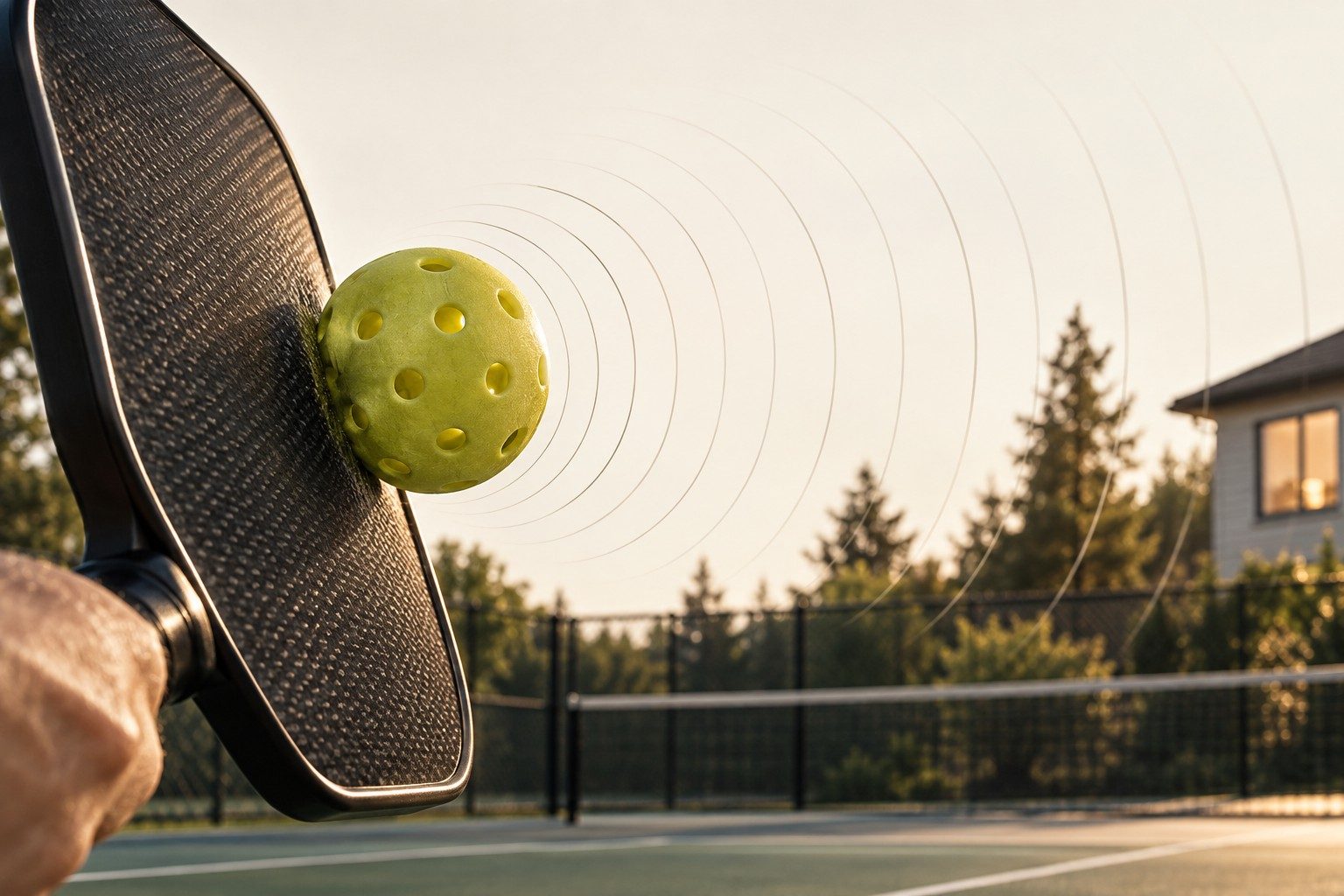
A pickleball paddle must be made of rigid, non-compressible material. The ball is a molded plastic sphere with 26 to 40 round holes [7]. When one meets the other, very little of the impact is absorbed. In 2025 a team from Penn State, Brigham Young University, Utah Valley University and a United States Navy acoustics laboratory tested thirteen paddles from ten brands in an anechoic chamber. They found that most of the sound comes from the paddle face itself, vibrating in what engineers call its first membrane mode, much as a drum skin vibrates when struck. That vibration typically sits between 980 and 1,477 hertz [8].
The same study found that material matters. Graphite and polymer paddles vibrated at higher frequencies and rang longer, with less damping. Wooden paddles vibrated lower and settled faster [8]. The finding matters for regulation, because it means the sound is a product of design, and design can change.
Acoustic consultants who specialize in pickleball have measured the strike as a pulse of about 3 to 5 thousandths of a second, followed by ringing that can last 20 thousandths of a second or more [9]. Measured at 4.4 feet, paddles produced maximum levels of 80 to 90 dBA, against 62 to 64 dBA for a tennis racquet under the same conditions [10]. At 100 feet, the same consultancy reports pickleball at about 70 dBA at its loudest, against 56 for tennis and 54 for basketball [11]. A separate statistical sample at 100 feet found an average maximum of 58.6 dBA and a highest reading of 71.9 dBA [9].
Measured as the acoustic power of each strike, a 2026 comparison of racket sports placed tennis at 95 decibels, padel at 100 and pickleball at 102.5 [12]. Because decibels are logarithmic, a difference of 7.5 decibels in sound power is a large one.
The sound is a product of design, and design can change.
In one measured sample, audible impacts occurred in just under a quarter of playing time, arriving as a random series rather than a rhythm [9]. A figure of about 900 pops per hour per court has been reported to the Acoustical Society of America by an author active in community noise advocacy, without a stated measurement basis, and is given here for context only [13].
Sound from a small source falls by about 6 decibels each time the distance doubles [11]. Courts do not add up the way intuition suggests: two sources of 50 decibels together make 53, not 100 [14]. More courts mean a modestly higher level and many more pops.
Most environmental noise rules are written around an average, the equivalent continuous sound level, written Leq. It spreads the energy of everything heard over a period of time into a single steady figure. That works well for traffic or a ventilation fan. It works badly for a sound that lasts a few thousandths of a second and then stops.
A 2020 study at a Florida club shows the problem plainly. With two or four courts in play, the average sound level at nearby homes differed from the background by less than 2 decibels at all but one location. Yet the same study found a 12 decibel difference between the impact levels of different paddles [15]. By the average, the courts were barely there. By ear, they were unmistakable.
A way of thinking about it: the flaw of averages
A statistician drowned crossing a river that was, on average, three feet deep. The phrase comes from Sam Savage of Stanford University: plans built on average conditions fail whenever what matters is the extreme. For pickleball, the extremes are the whole of the experience. An average includes the pops, but it can hide how sharp and noticeable each one is.
This is why the acoustic profession has proposed other measures for pickleball. One is the fast maximum level, written LAFmax, which captures the loudest moment of each strike. One consultant proposal would set a fast-maximum limit of 50 dBA at a home when background sound is 47 dBA or lower [16]. It has not been adopted as a general standard. Another is the sound exposure level, which captures the energy of each individual event [17]. Ontario's own provincial guideline for industrial sources counts impulses directly, with limits that tighten as the number of impulses per hour rises, and uses a meter setting designed for impulsive sound [18]. There is no settled answer yet, which is why the model by-law states a governing metric but reserves its final form for a licensed practitioner.
The international standard for describing environmental noise, ISO 1996-1, recognizes that sound with an impulsive character is more annoying than steady sound at the same average level. It deals with the difference by adding an adjustment before the sound is assessed: 5 decibels for regular impulsive sound, and 12 decibels for highly impulsive sound such as hammering on metal or pile driving. The standard's own examples of regular impulsive sound include outdoor ball games [19][20]. Health Canada's guidance for evaluating noise in federal assessments applies the same adjustments before estimating the share of people likely to be highly annoyed [21].
Canadian practice on pickleball has followed the 5 decibel route. The acoustic consultant who prepared planning guidelines for the City of Ottawa set a 50 dBA design limit by taking a 55 dBA benchmark and subtracting 5 dBA for the impulsive character of the sound [22]. The regional strategy for Victoria, Saanich, Oak Bay and Esquimalt did the same [23]. Some American consultants apply the larger 12 decibel adjustment; whether pickleball belongs in that category is not settled [20].
Laboratory research supports the principle and complicates the arithmetic. In a 2022 Finnish study, adults doing mental work under impulsive sound found it more annoying, more demanding and more draining than steady sound at the same average level of 65 dB. Stress hormone levels rose under both loud conditions compared with quiet; the extra burden of impulsiveness showed up in how people felt and performed [24]. A 2020 study found that the annoyance penalty for impulsive sound ranged from nothing to about 8 decibels, depending on how sharply the impulses rose and how far they stood above the background, and questioned whether any fixed adjustment is right [25]. A newer objective method, ISO/PAS 1996-3, calculates the adjustment from the sound itself, typically between 0 and 9 decibels [26].
Hearing declines with age, and it declines from the top down. Sensitivity to the highest frequencies begins to fall from about age 30 and is clearly reduced by 50 [27]. The pickleball pop, at roughly 1,000 to 1,500 hertz, sits well below the range that age takes first. Older residents, who may no longer hear birdsong or a smoke alarm's upper register as they once did, may still hear this clearly.
Hyperacusis, an abnormal intolerance of ordinary sounds, affects between 0.2 and 17.2 percent of the general population across the studies reviewed, with higher rates among adolescents, older adults, women, and people with tinnitus or autism [28]. Among autistic people, between half and seventy percent experience decreased sound tolerance at some point in their lives, and the sounds they report as most distressing are loud, sharp or high-pitched [29].
The World Health Organization identifies children, the chronically ill, older people and shift workers as groups at particular risk from night-time noise [30]. Pickleball is mainly a daytime activity, so that guidance bears most directly on early morning and evening play. No study was found that measures the effect of daytime recreational noise on people who are home during the day, such as retirees or people working from home, and this page does not claim one.
A 2025 survey presented to the Acoustical Society of America by a community noise organization reported that nearly three in four respondents living within 1,000 feet of courts could hear pickleball inside their homes [31]. Respondents chose to take part, so the survey shows that the experience is real for many people without showing how common it is.
One limit should be stated plainly. The World Health Organization's 2018 noise guidelines did not assess noise from neighbours or neighbourhood recreation [32]. Its figure of 70 decibels for leisure noise, averaged over a year, is aimed at protecting the hearing of the people taking part [37]. It was not written as a limit for the homes next door and should not be used as one.
Ontario's environmental noise guideline, NPC-300, sets numeric limits for stationary sources such as factories and mechanical equipment. It expressly excludes noise resulting from the gathering of people at facilities such as restaurants, fairs and parks, which it says is normally addressed in a qualitative manner in municipal noise by-laws [18]. The consultant who advised Ottawa observed that the provincial limits were not developed for recreational noise [22].
Toronto's noise by-law sets decibel limits for amplified sound: outdoors, 55 dBA from 7 a.m. to 11 p.m. and 50 dBA overnight [33]. The by-law also sets numeric limits for certain stationary sources. Other sounds may be assessed under its test for noise that is both unreasonable and persistent. Unreasonable noise is defined as noise that would disturb the peace, rest, enjoyment, comfort or convenience of a reasonable person in the circumstances. Persistent noise is noise heard continuously for ten minutes, or heard intermittently for a total of ten minutes over an hour [33]. No exemption for sport, recreation or parks was found in the by-law, and the by-law does not expressly say which provision an officer would apply to the sound of pickleball play. Whether a stream of pickleball strikes adds up to ten minutes in an hour is a question the by-law does not answer, and no enforcement guidance on it was found.
Ottawa's by-law prohibits noise likely to disturb the inhabitants of the City. When the City reviewed it in 2017, staff deliberately kept that subjective standard, reasoning that a fixed decibel limit would remove the discretion of officers, since a sound unnoticed downtown could be disturbing in a quiet suburb [34]. Niagara-on-the-Lake's by-law prohibited sound likely to disturb the quiet, peace, rest, enjoyment, comfort or convenience of its inhabitants. In 2022 a resident used that provision to prosecute the Town itself, and won. What happened in Niagara-on-the-Lake.
Put together, the picture is consistent. NPC-300 excludes noise from gatherings of people at places such as parks and points to municipal by-laws for that kind of noise. The municipal by-laws reviewed here rely on tests of reasonableness or likely disturbance, or set numeric limits written for other kinds of sources. None of them contains a number written for the sound of a paddle striking a ball. A subjective test can work well for a loud party, where everyone agrees what they heard. It serves nobody well for a sound whose average is low, whose peaks are high, and whose effect depends on how often it comes.
There are only a few places to intervene: where a court is built, what stands between the court and the homes, when it is used, and what makes the sound in the first place.
Distance is the most reliable and the most expensive, because it has to be chosen before a court is built. Setback distances compared.
Barriers work best when they block the direct path from the court to the listener [35]. A design that helps a ground-level neighbour may do much less for an upper-storey window. The British Columbia consultant recommends a barrier at least 3 metres above court level, with a surface density of at least 5 kilograms per square metre, for the situation it assessed [14].
The equipment is where the sound begins. Quieter paddles and balls can reduce levels by up to about 5 dBA, according to the Canadian consultant who prepared British Columbia's guidance [14], and the 2025 paddle study found that material and design shape the sound directly [8]. In 2023 USA Pickleball created a quiet category for equipment. Its test procedures are provided to manufacturers rather than published, and the figures reported for the first certified paddle, below 600 hertz and below 80 decibels, were released without a stated distance or measurement method [36]. Searches of the publicly available materials of CSA Group, the Standards Council of Canada and Pickleball Canada found no published Canadian standard for pickleball equipment noise as of 24 September 2026. Is there a Canadian standard?
A municipality cannot enforce a standard it cannot read. That is the gap the model by-law is written to fill: a numeric limit in place of a disturbance test, setbacks by court count and ground type, specified barriers, and an equipment schedule that provides a way to assess and adopt a future Canadian standard.